For years, women with lipoedema have been told that the surgery that removes diseased lipoedema tissue is ‘cosmetic’. In Australia, that label is the reason it has no MBS item number. Medicare deems liposuction ‘cosmetic and elective’, despite item number 45585 covering liposuction for conditions like lymphoedema, and items 31525 and 31526 covering liposuction for male gynaecomastia (breast tissue reduction).
So for women with lipoedema, there’s no Medicare rebate, no private health cover, and women pay anywhere between $15,000 to $150,000 for the surgery themselves.
In September 2026, The Lancet published the strongest evidence yet that the cosmetic label is wrong. The LIPLEG trial is the first large randomised controlled trial to compare liposuction with conservative therapy for lipoedema.2 The outcome it set out to measure was pain.
LIPLEG trial overview
The trial enrolled 410 women with lipoedema of the legs, at Stages 1 to 3, across 11 centres in Germany. Every woman had leg pain of at least 4 out of 10.
All of them first received conservative therapy, such as compression and manual lymphatic drainage. One group then had liposuction, and the other continued with conservative therapy alone. The team assessing the results did not know which treatment each woman had received.
A randomised controlled trial is the strongest kind of evidence in medicine, and it is the kind that funding bodies such as Australia’s Medical Services Advisory Committee look for when deciding what to fund.
What the trial found
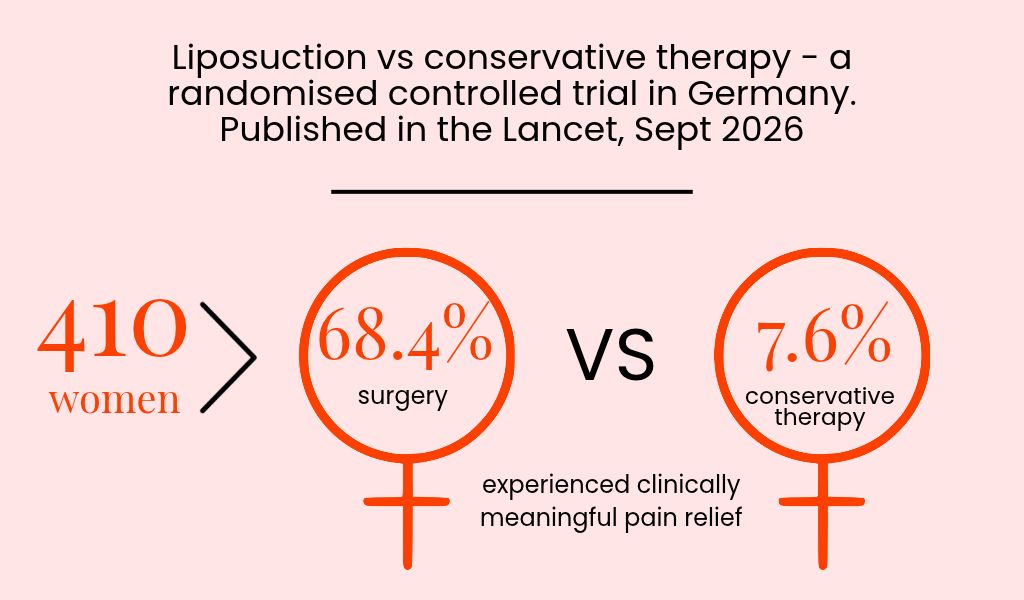
- Pain. After 12 months, 68% of women who had surgery (190 of 278) reported a clinically meaningful drop in leg pain, of at least 2 points on a 10-point scale. Among women who stayed on conservative therapy alone, the figure was 8% (10 of 132)
- Every stage benefited. The result held across Stages 1, 2 and 3
- Daily life improved. Women who had surgery also reported better quality of life, better physical functioning and less bruising
- Surgery carries risk. 47% of surgical patients had an adverse event, compared with 21% on conservative therapy. Serious events occurred in 7.5% and 3.4% respectively. Most were mild to moderate
Surgery is not risk-free, and it’s not right for every woman. But a treatment whose benefit is measured in less pain, better movement and a better quality of life is a medical treatment.
For the Australian women that would experience improved health outcomes as a result of this surgery – it should be a funded option, just like lymphoedema surgery, or gynecomastia surgery.
Expert guidelines already said this
The LIPLEG trial didn’t come out of nowhere – clinical experts in the United States and Germany had already reviewed the evidence and recommended surgery for painful lipoedema.
The Standard of Care for Lipedema in the United States, a consensus of clinicians and researchers published in 2021, states plainly: “This is not cosmetic liposuction as there are mobility, pain and health benefits when removing lipedema tissue”. It says surgery “significantly improves symptoms“, including mobility, stance and gait, and “also improves lymphatic symptoms, reducing the need for compression and manual therapy“. It also describes surgery as “currently the only available technique for removing abnormal lipedema tissue“.
Germany’s S2k guideline on lipoedema, published in 2024, was developed by specialist societies in phlebology, lymphology, dermatology, vascular surgery and plastic surgery, with a patient representative. It describes lipoedema as “always painful” and recommends that “Liposuction shall be used as surgical method of choice for the sustainable reduction of the affected subcutaneous adipose tissue of lipedema on legs and arms.” It says the decision to operate should no longer depend on the stage of the disease, because stage does not reflect how severe the symptoms are. And it reports that liposuction “results in pronounced improvements of spontaneous pain, pressure pain, and susceptibility to hematoma”, and “may permanently alleviate pain and improve the quality of life“.
Both guidelines are also clear about safeguards: conservative therapy first, experienced surgeons, and honesty about the risks. LIPLEG now provides randomised evidence for what these guidelines already recommend.
Germany now funds the surgery
On 17 July 2025, Germany’s Federal Joint Committee (G-BA), which decides what German public health insurance covers, ruled that liposuction for lipoedema would be covered at all stages. The decision was based on first results from the LIPLEG trial. Until then, cover had been limited to Stage 3.
A woman in Germany now qualifies after six months of conservative therapy without enough improvement, and any significant obesity must be treated first. Quality rules also apply to the doctors who diagnose and operate, to surgical planning and to follow-up. It is a working model of how a funded pathway can be built with clear safeguards.
What we don’t know yet…
The published results cover 12 months – the trial will follow the women for 36 months, which will show whether the benefit is lasting2. An earlier study that followed women for up to 12 years after liposuction found lasting reductions in pain and less need for compression and lymphatic drainage.
Whether surgery slows the disease is still debated. The US consensus describes surgery as “the only treatment that slows progression of lipedema”, based on observational evidence. Germany’s guideline takes a more cautious view, and says lipoedema should not be seen as generally progressive, because progression depends on factors such as weight gain and hormonal change5. The 36-month LIPLEG results will be the first randomised evidence on this question.
What this should mean for Australia
We now have a randomised trial, two expert guidelines and a national funding decision overseas all pointing the same way. Yet here, the surgery is still labelled cosmetic and tax-paying women still pay the full cost.
Two changes would make a real difference:
- Extend MBS item 45585 to lipoedema as an interim measure. It already funds liposuction for lymphoedema1, and Germany’s criteria show what the safeguards could look like.
- Fast-track an assessment by the Medical Services Advisory Committee. That assessment can now draw on a large randomised controlled trial and on Germany’s experience of funding the treatment.
I’ve shared this evidence with the Senate Select Committee on Women’s Health, which is looking at women’s pain, medical misogyny and the cost of treatment.
What you can do
- Share this article with your GP or specialist, especially if you’ve been told surgery is cosmetic.
- Share it with your federal MP.
- Follow Navigate Lipoedema on Instagram for updates as the 36-month LIPLEG results are released.
References
- Australian Government. Medicare Benefits Schedule, item 45585 (liposuction for lymphoedema). https://www.mbsonline.gov.au
- Podda M, Schmidt J, Cornely ME, et al. Liposuction versus conservative therapy for patients with lipoedema in Germany: a multicentre, randomised controlled clinical trial. The Lancet. 2026;408(10558):910-923. doi: 10.1016/S0140-6736(26)00910-4. Read the paper
- Lipedema Foundation. The LIPLEG Trial has been published! 4 September 2026.
- Herbst KL, Kahn LA, Iker E, et al. Standard of care for lipedema in the United States. Phlebology. 2021;36(10):779-796. doi: 10.1177/02683555211015887.
- Faerber G, Cornely M, Daubert C, et al. S2k guideline lipedema. Journal der Deutschen Dermatologischen Gesellschaft. 2024. doi: 10.1111/ddg.15513.
- Gemeinsamer Bundesausschuss (Federal Joint Committee, Germany). Media release on liposuction for lipoedema, 17 July 2025.
- Baumgartner A, et al. Improvements in patients with lipedema 4, 8 and 12 years after liposuction. Phlebology. 2021;36(2):152-159.