More than one million Australian women are estimated to have lipoedema 1– we pay income tax, the Medicare levy and private health insurance premiums, yet none of those systems will pay for the surgery that removes the diseased lipoedema tissue.
It seems universal healthcare is not so universal when the condition in question mostly affects women.
A snapshot:
- Lipoedema surgery is a form of liposuction, so it is treated as cosmetic and has no Medicare item number. That means no rebate and no private health cover, even though Medicare already funds liposuction for lymphoedema.2
- Surgery costs $15,000 to $150,000.
- The median wait for a diagnosis for lipoedema is 11 to 14 years in the early stages and 20 to 25 years in the late stages.3 Along the way, women see practitioner after practitioner for pain, swelling and joint problems, vascular problems, endocrine investigation – and those visits are rarely recorded as lipoedema.
- Each visit is a missed opportunity for data to be recorded properly – data that can then be used in research, to reduce diagnostic timelines and understand disease progression.
- The WHO, the United States and Australia’s own hospital coding system all recognise lipoedema as a diagnosis.4, 5, 6 But Australia still has no Medicare item for its surgery.
Two patients, two systems.
Consider two patients entering the Australian healthcare system:
The first is a man with erectile dysfunction after prostate cancer treatment. The system is ready for him: Medicare Benefits Schedule (MBS) items 37426 and 37429 provide rebates of $874.85 and $290.15 for penile prosthesis procedures 2, and under the Prescribed List of Medical Devices and Human Tissue Products (formerly the Prostheses List), the device is 100% covered by private health insurance 4. His condition is coded, tracked, funded and visible, as it should be in a universal healthcare system.
The second is a woman with painful stage 3 lipoedema – a genetically determined, WHO-recognised 5 loose connective tissue disorder that causes chronic pain, progressive inflammation and in time, physical disability through loss of mobility. Lipoedema almost exclusively affects women. She has paid taxes, the Medicare levy and private health insurance premiums her entire working life. The Commonwealth offers her no help with the treatment that matters most – in fact, the government doesn’t even acknowledge the disease exists. There is no MBS item number for lipoedema surgery, because the procedure – liposuction – is treated as ‘cosmetic’. Because legislation ties private insurance cover to MBS codes, there is no path to privately insured surgery either.
What is lipoedema?
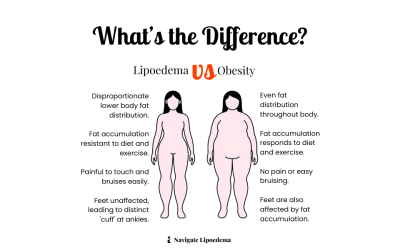
Lipoedema is a progressive, genetically determined disease of the loose connective tissue that causes chronic pain, inflammation, prolific growth of diseased adipose tissue in a very specific pattern on the body, fibrosis and – if left untreated and unmanaged – it can result in significant permanent disability.
Its biology is increasingly well understood. Australia’s own Associate Professor Ramin Shayan and Associate Professor Tara Karnezis at St Vincent’s Institute of Medical Research have published compelling evidence that lipoedema is driven by dysfunction in adipose-derived stem cells, a cellular-level pathology as biologically grounded as Type 1 diabetes. 8Research is also pointing to the blood and lymphatic vessels. A 2026 review describes growing evidence that fragile, leaky small vessels drive swelling and inflammation, and that these changes feed the growth and scarring of fat tissue.9 The exact mechanism is still being worked out, but what is no longer in question is that lipoedema is a disease.
Women are paying into a system that does not cover them equally.
The missing MBS code effectively works as a financial trap – Australian private health insurers are limited by law from covering procedures that have no matching Medicare code. So a woman with lipoedema can’t get surgical treatment through any of the three systems she has paid into: not Medicare, not the Medicare levy, not private insurance.
Don’t get me wrong, some care is subsidised – a woman with lipoedema can see a GP or specialist under general Medicare items; and treatment for related conditions, such as venous insufficiency, attracts a rebate when the item’s clinical criteria are met (i.e when the diagnosis of lipoedema is not mentioned). No item, however, covers treatment of lipoedema itself, and as far as I can tell, none of these appointments records lipoedema as the reason for the visit.
Surgery isn’t the right treatment for everyone with lipoedema, but for those who fit the criteria it can be life-changing. It’s evidence-based, specialised lymph-sparing liposuction that carefully removes the diseased tissue (including hard fibrotic nodules) – significantly slowing the lipoedema’s progression, reducing the hallmark pain and swelling, and stopping the inflammation cycle. In Australia it can cost anywhere between $15,000 to $150,000 depending on disease severity and stage. Facebook groups are full of women discussing how they are accessing their superannuation early to pay for surgery, or selling their home to afford it – risking poverty for pain relief, after paying into Medicare their whole working life.
The Medicare team already acknoweldges that quality of life matters.
But when we zoom out and look at what Medicare is currently supporting, the picture shows an increasingly concerning bias. The MBS provides a rebate for inserting an artificial erection device under item 37426. It also funds bilateral surgery for gynaecomastia, with or without liposuction, under item 31526 when its clinical criteria are met.
Every figure in the table below is drawn directly from the July 2026 Medicare Benefits Schedule: 2
| Condition |
MBS item? |
Clinical reality |
Medicare status |
Years coded |
| Erectile dysfunction |
YES (37415, 37426, 37429) |
Quality of life / sexual health |
$290.15 to $874.85 rebate (implants) |
30+ years |
| Vasectomy reversal |
YES (37616, 37619) |
Reverses a sterilisation the man chose to have. |
$248.30 to $620.65 rebate per side |
30+ years (since 1991) |
| Penile curvature |
YES (37417, 37418) |
Straightening a curved penis |
$501.05 to $665.60 rebate |
30+ years (since 1991) |
| Gynaecomastia |
YES (31525, 31526) |
Removal of male breast tissue |
$466.80 (one side) to $816.90 (both sides) rebate |
12 years (since 2014) |
| Adenomyosis |
NO |
Hidden under general gynae/hysterectomy codes |
Invisible in treatment data |
0 |
| PCOS |
NO |
Managed via generic GP/endocrine codes |
No specific tracking |
0 |
| Endometriosis |
PARTIAL |
Only severe cases have specific codes |
Historically underfunded |
Partial |
| Lipoedema |
NO |
Prevention of immobility, disability and pain |
Labelled ‘cosmetic’ |
0 |
All dates and figures were correct at the time of publication (17 Oct 2026).
These are legitimate treatments and men should continue to receive them – calling any of them merely ‘cosmetic’ would repeat the very mistake women with lipoedema are challenging: judging a procedure by the body part involved rather than its clinical purpose.
But the comparison exposes a question that Australian healthcare policy-makers need to answer. If restoring function and quality of life justifies treatment in conditions suffered by Australian men, why is there no dedicated surgical funding pathway for Australian women seeking relief from the relentless pain and debilitating progression of lipoedema?
The argument is not that men receive too much – it’s that women are being asked to accept too little.
Recognised here and overseas, but not funded.
Australia’s own classification authority recognised lipoedema as a diagnosis in 2022 7, yet there’s still no Medicare item for its surgery, and no lipoedema application appears on the Medical Services Advisory Committee’s public list (as at today, 11th Oct 2026).10 Without an item number, Medicare data cannot show how many women are treated, what it costs or what works.
The World Health Organisation gave lipoedema its own code, EF02.2, in ICD-11, which came into effect in 2022.5 The United States is now following. The National Center for Health Statistics, the arm of the Centers for Disease Control and Prevention (CDC) that maintains America’s diagnosis codes, has accepted dedicated codes for lipoedema. They are expected to take effect on 1 October 2027.6 From then, American clinicians and insurers will be able to record lipoedema as lipoedema. Germany already codes the condition by stage6 , and Australia added its own hospital diagnosis code, E88.4, in 2022.7
Overseas, the condition has its own medical infrastructure. In the United States, The Roxbury Institute runs lipoedema clinics in Los Angeles, Salt Lake City and Tucson that cover diagnosis, conservative treatment, surgical removal and research.11 Dr Karen Herbst, one of the world’s best-known lipoedema researchers, practises there. In 2023 clinicians and researchers met in Potsdam for a Lipedema World Congress, and the consensus paper that came out of it, published in Nature Communications, includes Australian authors.12 Embarrassingly, the Lipedema World Congress will be held right here in Australia, in Melbourne in November 2027 13, yet our own government deems lipoedema nothing more than a ‘cosmetic’ issue.
Dedicated clinics, research programs, international congresses and a WHO code all point to a recognised disease, and Australia’s billing system has yet to reflect that.
Up to 25 years to diagnose.
The peer-reviewed evidence on diagnostic delay in lipoedema is shocking to say the least. A 2022 study by Clarke and colleagues, conducted through Central Queensland University, Brisbane and published in Quality of Life Research, surveyed more than 1,300 people with lipoedema across several countries, including Australia.3 It should be required reading for every member of MSAC.
For a Stage 1 to 2 patient (in the earlier and more treatable phase), the median wait for a correct diagnosis is 11 to 14 years. For a Stage 3 to 4 patient, already living with mobility loss, lymphoedema, depression and often the loss of a job, the median climbs to 20 to 25 years.3 The Australian healthcare system gets less responsive as the disease gets worse.
My own diagnosis took 14 years – I’m a Stage 1 patient with few ‘visible’ signs of the disease, but a complex collection of seemingly unrelated symptoms: decades of chronic pain, swelling, ‘random’ and rapid weight gain, joint issues, vascular issues and constant systemic inflammation. In the 14 years I saw multiple GPs about the weight gain, swelling and inflammation, a podiatrist, a sports physician and an orthopaedic surgeon for bone and joint injuries and severe pain, two physiotherapists, an exercise physiologist, an acupuncturist, a neurologist and a medical specialist at a lymphoedema/lipoedema research centre. By the time an endocrinologist finally confirmed it, I had already recognised the condition myself from posts on social media, and built my own treatment program.
None of those appointments over the 14 years would show up as lipoedema in Medicare data, and some were not Medicare services at all. If they were, I would have potentially been diagnosed years earlier. I was persistent – but many women stop at the first inexperienced GP who tells them to ‘lose weight’, feeling dismissed and powerless.
The result is a black hole in the data. Each consultation is recorded as something else, so years of appointments, misdiagnoses and decline never add up to a lipoedema record. Data that is never recorded cannot train diagnostic tools, inform clinical guidelines or build the evidence that would force a policy change.
The Medicare gendered coding gap: if it isn’t counted, it doesn’t get funded.
I’ve worked on TGA registrations, Prostheses List funding submissions and real-world data programs built on Medicare data, so I’ve seen how this system works: what isn’t counted isn’t funded. For women with lipoedema, the missing item number means no rebate, obviously, but it also means no data, and without data there is little policy pressure and no funding case.
Compare that with men’s health. Erectile dysfunction and gynaecomastia, including some quality-of-life procedures, have their own item numbers, so every treatment is tracked and subsidised. Over the years that builds deep pools of longitudinal data called Real World Data (RWD) – one of the most powerful tools in 21st century medicine – which drives more research, better outcomes and more funding. Women’s chronic, often debilitating and progressive conditions miss out on this cycle and on the insights and improved health outcomes that RWD provides – costing us more than just money.
RWD is the pool of clinical records created when conditions are coded, billed and tracked; and for the best part of a decade, machine learning and AI have been used to analyse that data and make significant leaps forward in the way that rare and complex diseases are managed around the world. Conditions that once took decades to identify are being flagged in a fraction of the time using machine learning and AI. For lipoedema, where diagnosis can take up to 25 years and disease progression is still not fully understood, the gains for patients could be enormous. But each year without a Medicare item number is another year of lost data.
The $6 billion blind spot.
Without a billing code, lipoedema’s economic footprint has to be estimated instead of measured – a policy failure in itself.
There’s no official figure for what lipoedema costs Australia. I built a rough model from the numbers that do exist: ABS population and earnings data, NDIS payment data, and published Australian costs for hospital treatment of cellulitis, compression therapy and joint replacement. On those numbers, untreated lipoedema costs Australia an estimated $6.5 billion a year, with much of that cost being lost work, as women with late-stage disease cut their hours or leave the workforce. The rest falls on the NDIS and on hospitals treating the complications.
Because so much has to be estimated, the model had to leave out what women pay for surgery themselves, mental health care, unpaid carers, GP and specialist visits, and lost tax, so even the central figure is likely to understate the true cost.
If around one in nine Australian women has lipoedema and half have late-stage disease, refusing to fund treatment simply defers a larger, more expensive (and less reversible) bill. How can this possibly be considered a smart economic move?
The promises are already on paper.
The government’s own plans already promise what women with lipoedema are asking for, in The National Women’s Health Strategy 2020-2030. 14 It describes chronic conditions as the leading cause of illness, disability and death in Australia and commits to targeting diagnostic delay, to making care more affordable and accessible throughout Australia, and to collecting more detailed data on women’s health. It names endometriosis, PCOS and primary ovarian insufficiency (thank god) but doesn’t mention lipoedema once.
In August 2026 the Senate set up a Select Committee on Women’s Health.15 Among a host of other things, it will be examining how women experience long-lasting pain, their experience of seeking care for it, including medical misogyny, and the barriers to effective pain management, including what treatment costs. Lipoedema is a textbook case of all three: a painful disease that GPs dismiss, a treatment labelled ‘cosmetic’, and a bill that women are left to pay in full whilst also paying into a system for everyone else’s care. I don’t know about you reader, but that feels a lot to me like we’re being exploited.
The same gap affects other women’s conditions.
Lipoedema is an obvious example of Medicare’s blatant gendered coding gap, but it’s not the only one. Adenomyosis is found in an estimated 41 to 49% of women with gynaecological symptoms 16– it has no dedicated treatment code and is buried in generic gynaecology and hysterectomy billing categories. PCOS affects an estimated 10 to 13% of women 17and is managed under generic endocrine codes with no specific tracking. Endometriosis has only partial coding, which has historically covered only its most severe forms.
It’s a systemic pattern – each of these conditions has the same black hole as lipoedema: the visits, tests and treatments happen, but they are billed under general Medicare items, so their true prevalence and impact cannot be measured. Women’s chronic pain conditions are uncoded, undercoded, or filed in ways that hide their true burden from the people who decide on funding.
What needs to happen?
The policy path couldn’t be much clearer. The evidence and international precedent already exist – the delay appears to to just be political will.
- Commission and fast-track an MSAC assessment of lymph-sparing liposuction for lipoedema, led by the Health Minister, so the work does not fall to a volunteer patient group.
- Make lipoedema treatment visible in national data, through an MBS item and consistent use of the existing diagnosis code, E88.4, so that its use, cost and outcomes can be measured.
- Amend the Private Health Insurance Regulations to allow cover for evidence-based treatments in the period between a condition being recognised in Australia’s diagnosis codes (for lipoedema, ICD-10-AM E88.4 since 2022) and MBS listing.
- Commission a formal review of the Gender Coding Gap across the MBS, identifying every condition where coding differs by sex and setting a timeline to fix it.
Australia has the clinical expertise, the international evidence and the WHO classification to work from. Women with lipoedema have done everything the system asks of them. They are still waiting, and every year without treatment moves many of them to a more advanced stage.
Their taxes, Medicare levies and insurance premiums have earned them the right to walk, work and live without a preventable disability and it’s time the MBS reflected that.
What you can do:
Source & References
- Buso G, et al. Lipedema: a call to action! Obesity. 2019;27(10):1567-1576. doi: 10.1002/oby.22597.
- Australian Government. Medicare Benefits Schedule (July 2026): Items 37426 ($1,166.45 fee / $874.85 benefit), 37429 ($386.85 fee / $290.15 benefit), 31525 ($622.35 fee / $466.80 benefit), 31526 ($1,089.20 fee / $816.90 benefit), 37616 ($827.50 fee / $620.65 benefit), 37619 ($331.05 fee / $248.30 benefit), 37417 ($668.05 fee / $501.05 benefit), 37418 ($887.45 fee / $665.60 benefit), 45585 (liposuction for lymphoedema). Viewed October 2026.
- Clarke C, Kirby JN, Smidt T, Best T. Stages of lipoedema: experiences of physical and mental health and health care. Quality of Life Research. 2022 Aug 16;32(1):127-137. doi: 10.1007/s11136-022-03216-w. PMC9829602.
- Australian Government Department of Health, Disability and Ageing. About the Prescribed List of Medical Devices and Human Tissue Products (formerly the Prostheses List).
https://www.health.gov.au/our-work/the-prescribed-list/about, viewed 11 October 2026.
- World Health Organisation. ICD-11 for Mortality and Morbidity Statistics. Code EF02.2: Lipoedema. In effect from 2022.
- US National Center for Health Statistics (CDC). ICD-10 Coordination and Maintenance Committee, diagnosis agenda, March 2026: lipedema and lipolymphedema. Lipedema Foundation, ICD (Diagnosis) Codes, viewed 7 October 2026.
- Independent Health and Aged Care Pricing Authority. Summary of updates for ICD-10-AM/ACHI/ACS Twelfth Edition (new code E88.4 Lipoedema). Applies from 1 July 2022.
- Ishaq M, Bandara N, Morgan S, et al, including Shayan R and Karnezis T. Key signaling networks are dysregulated in patients with the adipose tissue disorder, lipedema. International Journal of Obesity. 2022. doi: 10.1038/s41366-021-01002-1.
- Vascular changes and their implications in lipedema. Frontiers in Cell and Developmental Biology. 2026.
- Medical Services Advisory Committee. Public list of applications, searched October 2026. No lipoedema application listed.
- The Roxbury Institute. theroxburyinstitute.com, viewed 8 October 2026.
- Kruppa P, et al. Lipedema World Alliance Delphi consensus-based position paper on the definition and management of lipedema: results from the 2023 Lipedema World Congress in Potsdam. Nature Communications. 2026. doi: 10.1038/s41467-025-68232-z.
- Lipoedema Australia. Lipedema World Congress III, co-located with Lipoedema Australia Conference VII, Melbourne, November 2027. https://www.lipoedema.org.au/conference, viewed 11 October 2026.
- Australian Government. National Women’s Health Strategy 2020-2030.
- Parliament of Australia. Senate Select Committee on Women’s Health, terms of reference. Established 19 August 2026.
- Wang MH, Chen JH, Qi XY, Li ZX, Huang Y. Global prevalence of adenomyosis and endometriosis: a systematic review and meta-analysis. Reproductive Biology and Endocrinology. 2025 Nov 19;23:148. doi: 10.1186/s12958-025-01483-z. PMC12629041. https://pmc.ncbi.nlm.nih.gov/articles/PMC12629041/
- World Health Organization. Polycystic ovary syndrome, fact sheet, 22 January 2026. https://www.who.int/news-room/fact-sheets/detail/polycystic-ovary-syndrome