

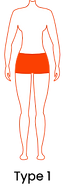
Type 1
Build up of lipoedema tissue between the navel and hips – pelvis, buttocks and hips. This type has a distinctive ‘saddlebag’ appearance.

Recognising the signs and distinguishing lipoedema from other conditions can put you on the path to clinical diagnosis, and help you take control of your health. But while self-diagnosis can be a helpful first step, it's important to also seek a clinical diagnosis to confirm the condition and rule out other potential issues.
By learning how to identify lipoedema at home, you can better understand your symptoms and take the necessary steps towards managing the condition.
Work through Lipoedema Australia’s checklist so your symptoms are ready to describe.
Get the checklistCompare the shape of your body against the five types and four stages.
View types and stagesSelf-diagnosis is a legitimate and often necessary first step. Because many doctors are still unfamiliar with lipoedema, knowing your symptoms and where your body changes sit on the types and stages makes a real difference. A clinical assessment can then confirm what you have found and open the door to the right care.
To accurately identify lipoedema at home, you need to become familiar with lipoedema symptoms, causes, types and stages. Use the Self Diagnosis Video below by Dr David Amron to assess your body for lipoedema, and use the Symptom Checklist from Lipoedema Australia to record your symptoms for your doctor. Then scroll further for detail on the Types and Stages of Lipoedema to get an early understanding of which type and stage you may have – your doctor will also assess this during clinical assessment and diagnosis.
Great How-To videos by Dr Amron and Dr Herbst.
Click the image below to download Lipoedema Australia's fantastic Symptom Checklist.

There are 5 types of lipoedema categorised by the area of the body they impact and it’s not uncommon to have a combination:
Build up of lipoedema tissue between the navel and hips – pelvis, buttocks and hips. This type has a distinctive ‘saddlebag’ appearance.
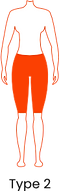
Buildup of lipoedema tissue from buttocks to knees, with folds of fat around the inner side of the knee. More common than Type 1 and causes swelling and fat buildup from the waist to the knees.
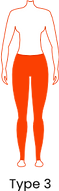
Buildup of lipoedema tissue from the buttocks to ankles. Most common type found in women and affects the entire lower body which causes it to become disproportionate to the rest of the body.
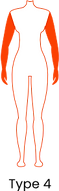
Buildup of lipoedema tissue in the upper arms, lower arms or both.
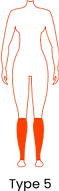
Buildup of lipoedema tissue in the lower legs i.e calves.
It’s common to have a combination of types, most often Type 2 & 4 or Type 3 & 4.
Lipoedema is a progressive condition, which means it gets worse over time if left untreated. The progression is broken down into 4 categories:


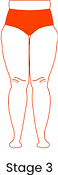
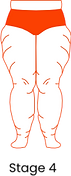
Once you've assessed your symptoms, learn how to build a plan for diagnosis and treatment.
Make A PlanFree short learning program
Self-advocacy is simply knowing what to say, and what to show, so your symptoms are taken seriously. Our free Self-Advocacy program walks you through it in a few short lessons, with a workbook you can take to your appointment.
We use cookies to make our website work better. By using our website, you agree to the cookies policy - you can learn more about the policy here. If you don't want to use cookies, you can .


